


As an indispensable operating component in mechanical equipment, the material selection of the handwheel directly affects the service life, operational safety and maintenance cost of the equipment. From high-temperature furnace door adjustment to precision instrument control, the requirements for material strength, corrosion resistance, lightweight and other properties in different scenarios vary significantly. Based on Hangzhou Xiaoshan Chuangye Metal Processing Co., Ltd.'s more than 20 years of experience in handwheel manufacturing, this article deeply analyzes the core characteristics of five commonly used materials such as carbon steel, stainless steel, and aluminum alloy, and provides scenario-based selection strategies to help industrial users accurately match their needs.
Table of Contents
1. Five core indicators for handwheel selection
2. Carbon steel handwheel
3. Stainless steel handwheel
4. Aluminum alloy handwheel
5. Engineering plastic handwheel
6. Cast iron handwheel
7. Selection misunderstandings
8. Hangzhou Xiaoshan Chuangye Metal's solution
9. Industry trends: How new materials reshape the design logic of handwheels
1. Five core indicators for handwheel selection
| Index | Definition | Test standard |
|---|---|---|
| Tensile strength | Maximum stress that a material can withstand before breaking | ASTM E8/E8M (metallic materials) |
| Corrosion resistance | Ability to resist acid, alkali and salt spray corrosion | ISO 9227 (neutral salt spray test) |
| Specific gravity | Weight per unit volume, affecting ease of operation | ASTM D792 (plastics) |
| Thermal conductivity | Heat transfer efficiency, related to suitability for high temperature environments | ASTM C177 (steady-state heat flow method) |
| Processing cost | Comprehensive cost of raw materials and molding process | - |
Key principle: prioritize matching the most stringent working conditions to avoid cost waste caused by "excess performance".
2. Carbon steel handwheel
Material characteristics
Composition: C content 0.12%-0.20%, Mn content 0.30%-0.60% (refer to carbon steel handwheel technical parameters).
Tensile strength: ≥370MPa (Q235 level), can bear torque up to 200N·m (φ500mm handwheel).
Surface treatment: galvanized, blackened or sprayed, no red rust after 480 hours of salt spray test.
Applicable scenarios
Heavy machine tools: manual adjustment of stamping machines and bending machines.
Mining machinery: valve control in high vibration environment.
Limitations: Regular oiling is required to prevent rust in humid environments, and the long-term maintenance cost is high.
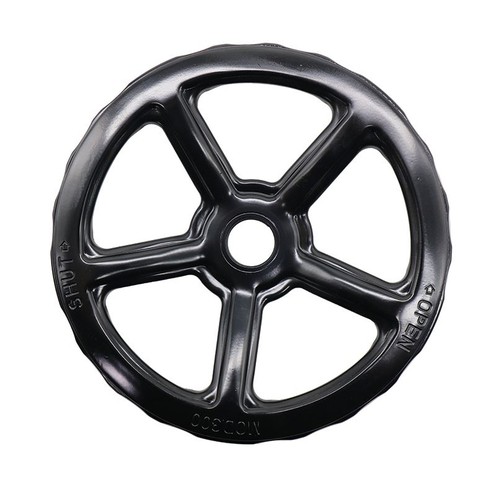
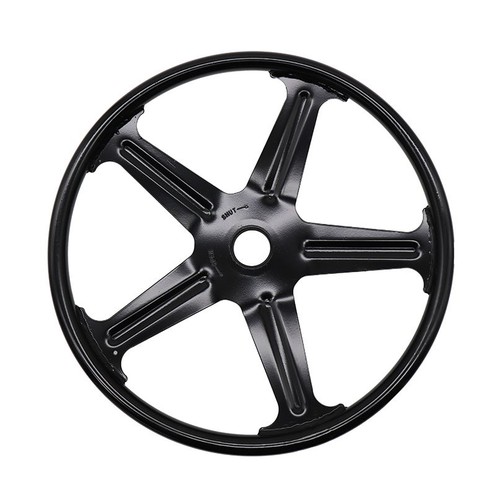
Hangzhou Xiaoshan case: Customized φ800mm carbon steel welded handwheel for a forging equipment manufacturer. The wheel hub adopts a D-type hole + keyway double fixed design, and can withstand an instantaneous impact load of 15 tons.

3. Stainless steel handwheel
Material characteristics
Grade selection:
304 stainless steel: general grade, resistant to weak acids and alkalis (pH 3-11), moderate cost.
316L stainless steel: contains Mo element, resistant to chloride corrosion (such as marine environment).
Tensile strength: ≥520MPa (304 material), 40% higher than carbon steel.
Maintenance-free: can withstand 95% humidity environment through passivation treatment (see stainless steel handwheel technical documentation).
Applicable scenarios
Chemical equipment: reactor pressure regulation, acid and alkali pipeline valves.
Food and pharmaceutical: meets FDA contact standards, easy to clean without residue.
Limitations: The cost of raw materials is 2-3 times that of carbon steel, and it is not recommended for pure mechanical load scenarios.


4. Aluminum alloy handwheel
Material characteristics
Grade selection:
6061-T6: High strength (tensile strength ≥ 310MPa), aviation-grade application.
5052-H32: Seawater corrosion resistant, preferred for ship equipment.
Specific gravity: 2.7g/cm³, 65% lighter than carbon steel.
Conductivity: 59% IACS (International Annealed Copper Standard), use with caution in insulation scenarios.
Applicable scenarios
Electronic equipment: Semiconductor wafer handling robot.
Mobile device: Vehicle-mounted radar pitch angle adjustment.
Limitations: Low hardness (HB 95), easily scratched by hard objects.
5. Engineering plastic handwheel
Material characteristics
Nylon PA66: Tensile strength 80MPa, flame retardant grade V0 (UL94 standard).
Polypropylene PP: Acid and alkali resistant (pH 1-14), but low-temperature brittleness is obvious (<-10℃).
Cost advantage: The unit price of mass production is 1/5 of that of stainless steel handwheel.
Applicable scenarios
Low-voltage electrical cabinet: Circuit breaker operation with insulation requirements higher than IP65.
Laboratory instruments: Precision adjustment without magnetic interference.
Limitations: Easy to age and crack under long-term ultraviolet radiation.
6. Cast iron handwheel
Material characteristics
Gray cast iron HT250: The lowest cost, but the tensile strength is only 250MPa.
Ductile iron QT450: Elongation is increased to 10%, and impact resistance is improved.
Surface treatment: Epoxy resin coating makes up for the shortcomings of rust prevention.
Applicable scenarios
Agricultural machinery: Manual backup control of tractor hydraulic system.
Low-speed equipment: Ventilation duct damper adjustment.
Limitations: High brittleness, strictly prohibited for high-frequency vibration scenarios.


7. Selection misunderstanding: Typical failure cases caused by mixed materials
Case 1: A water treatment plant used a carbon steel handwheel on the valve of a hydrochloric acid storage tank. After 6 months, the spokes rusted and broke. After replacing it with a 316L stainless steel handwheel, the service life exceeded 5 years.
Case 2: A nylon handwheel was used on an aerial work platform. The control system malfunctioned due to static electricity accumulation. After switching to aluminum alloy, the failure rate returned to zero.
Lessons learned: Relying solely on "material selection based on experience" or "cost priority" principles can easily lead to chain risks, and working conditions parameters must be strictly followed.
8. Customized practice: Hangzhou Xiaoshan Chuangye Metal's solution
Hangzhou Xiaoshan Chuangye Metal Processing Co., Ltd. (official website: www.cyhandwheel.com) relies on the ISO 9001:2015 quality management system to provide a full-process service of "demand analysis-material selection-process design":
(1) Extreme environment response plan
High temperature scenario: Customized 310S stainless steel handwheel (temperature resistance 1150℃) for steel mills, and heat-insulating silicone sleeves were installed on the wheel rims.
Ultra-low temperature scenario: LC9 aluminum alloy (-196℃ impact toughness ≥ 27J) is used for LNG tank valves.
(2) Lightweight innovative design
Hollow spokes: Achieve 30% weight reduction on φ600mm handwheels while maintaining 400N·m torque load.
Composite material: stainless steel hub + PP rim, taking into account both structural strength and corrosion resistance.
(3) Fast delivery capability
30 minutes direct access to Xiaoshan International Airport, ensuring that urgent orders from European and American customers arrive within 7 days.
Support non-standard design: minimum order quantity 1 piece, provide 3D drawing confirmation service.
9. Industry trend: How new materials reshape the design logic of handwheels
Carbon fiber reinforced plastic (CFRP): 5 times stronger than aluminum alloy, has been used for spacecraft adjustment handwheels.
Metal injection molding (MIM): Realize integrated manufacturing of complex structures of stainless steel handwheels with an accuracy of ±0.05mm.
Intelligent sensor integration: The handwheel with built-in torque sensor can provide real-time feedback on operating force and warn of overload.
Conclusion
Scientific material selection is the first line of defense for equipment reliability
Although the handwheel is small, it is the key hub of human-machine interaction. From the heaviness of carbon steel to the toughness of stainless steel, from the flexibility of aluminum alloy to the economy of engineering plastics, each material is irreplaceable in a specific scenario. Hangzhou Xiaoshan Chuangye Metal has been deeply involved in the industry for 20 years, and has always taken "working condition adaptation" as the core principle to provide global customers with full-size, multi-material handwheel customization services from φ120 to φ1200.
Visit www.cyhandwheel.com now to download the "Handwheel Material Selection Manual" or submit your customization requirements.


