


In industrial control, mechanical equipment and fluid systems, handwheels are core components of manual operation. Their correct use directly affects the equipment's operating efficiency, operational safety and service life. From high-temperature valves in thermal power plants to the feed systems of precision machine tools, the operating logic of handwheels runs through many fields of mechanical engineering. This article will analyze the core methods of scientifically using handwheels from the dimensions of operating principles, process specifications, type adaptation, special scenario response and maintenance strategies, combined with industry standards and practical experience, to provide industrial practitioners and equipment operation and maintenance personnel with a practical operating guide.
Table of Contents
1. Preparation before use: the core logic of working condition analysis and safety inspection
2. Basic operation specifications: standard process of opening, closing and adjustment
3. Type adaptation skills: differentiated operation points of handwheels with different structures
4. Special scenario response: operation strategies for high temperature, high pressure and explosion-proof environment
5. Ergonomic optimization: operating force control and anti-misoperation design
6. Maintenance and care: key measures and life management after use
7. Common problem solving: investigation and treatment of jamming, overload and leakage
8. Cutting-edge technology: digital operation and future trends of smart handwheels
9. Summary: industrial philosophy from manual operation to intelligent interaction
1. Preparation before use: the core logic of working condition analysis and safety inspection
1. Confirmation of working condition parameters
Three-element verification:
Medium characteristics: confirm the compatibility of handwheel material and medium (such as 316L stainless steel handwheel is suitable for chloride ions ≤1000ppm, fiberglass handwheel is acid and alkali resistant but avoid strong oxidants).
Working pressure/temperature: For high pressure conditions (>10MPa), the connection strength between the handwheel and the valve stem needs to be checked (such as the involute spline fit tolerance H7/g6). For high temperature environments (>300℃), the temperature resistance grade of the grease needs to be confirmed (such as molybdenum disulfide grease with a temperature resistance of 260℃, bentonite grease needs to be used instead).
Operating torque: Obtain the theoretical torque from the valve specification (such as the full opening torque of a DN200 gate valve is about 80N・m), and evaluate whether the handwheel diameter matches (torque = force × radius, the recommended operating force is ≤50N, so the handwheel radius is ≥160mm).
2. Equipment status inspection
Physical inspection list:
Handwheel body: cracks (visual or penetration inspection, crack depth>1mm needs to be replaced), deformation (rim runout>0.5mm affects operating accuracy).
Connecting parts: clearance between hub and valve stem keyway (standard 0.02-0.05mm, more than 0.1mm will cause slippage), fixing bolt torque (such as M8 bolts need to be re-tightened at 20N・m to prevent loosening).
Lubrication status: lack of grease at the metal handwheel hub (replenish when it feels dry, recommended lithium-based grease penetration 265-295).
3. Personal protective equipment
Conventional scenarios: wear non-slip gloves (friction coefficient ≥ 0.6, such as nitrile gloves) and wear anti-smashing shoes (in accordance with GB 21148 standard).
Special environment: use heat-insulating gloves (temperature resistance above 300℃) in high temperature scenarios (>200℃), wear anti-static work clothes (charge leakage time <0.1 second) in explosion-proof areas (such as Ex IIB T3 environment).
2. Basic operation specifications: standard process for opening, closing and adjustment
1. Opening operation (taking gate valve as an example)
① Pre-determine the direction
Follow the general principle of "clockwise to close, counterclockwise to open" (some imported valves may be reversed, and the handwheel arrow mark or manufacturer's instructions must be confirmed).
Special design: The handwheel of a German standard valve uses a double arrow mark. When the arrow points to "OPEN", it rotates counterclockwise to avoid misjudgment of direction.
② Apply force at a uniform speed
Hold the wheel rim with both hands (the thumb and the other four fingers are held together, and the contact area is ≥80%), apply force at a uniform speed (angular velocity ≤15°/second), and avoid impact loads (impact torque may exceed the rated value by 30%, causing keyway wear).
Data reference: During the opening process of the DN150 valve, the torque curve should rise smoothly to the peak value (about 60N・m) and then decline. If there is a sudden increase (>10%) in the middle, stop immediately to check whether it is stuck.
③ Confirmation of position
Fully open state: rotate the handwheel until the limit device is triggered (such as metal collision sound), or observe the valve stem displacement scale (error ≤2% stroke).
Case: A water plant did not confirm that it was fully open, resulting in a valve opening of less than 30%, a 15% increase in pipeline pressure drop, and a 10% increase in energy consumption.
2. Closing operation
Force control: reduce the force when approaching the closed position (about 70% of the peak torque) to prevent overload of the sealing surface (such as soft sealing valve sealing pressure exceeding the design value by 20%, which will cause the sealing ring to fail).
Double confirmation: retreat 1/4 turn after closing (part of the butterfly valve design) to avoid plastic deformation of the sealing ring due to long-term load, and observe the pressure gauge at the same time (pressure drop ≤0.05MPa means good sealing).
3. Adjustment operation (taking the regulating valve as an example)
Precision control: The handwheel with scale (scale spacing 5°) needs to be positioned with the pointer, and the single adjustment amount is ≤10° (corresponding to a flow change of about 5%). A torque wrench (accuracy ±2%) is used in important working conditions to ensure the consistency of adjustment.
Dynamic monitoring: Monitor the downstream pressure/flow (such as PID control system feedback) during the adjustment process. Stop the operation when abnormal fluctuations (>5%) are found, and check whether there is handwheel scale error or valve internal wear.
3. Type adaptation skills: Differentiated operation points of handwheels with different structures
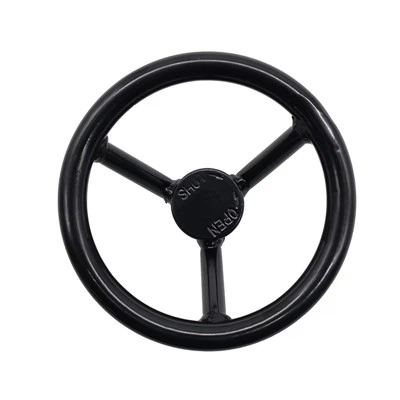
1. Spoke handwheel (light load and high frequency scenario)
Advantages: light weight (20% lighter than the spoke plate type), good heat dissipation, suitable for fast switching (such as fire valves require full opening within 10 seconds).
Operation points: Hold the rim with one hand (the thumb is against the spoke to enhance stability), keep the wrist force even when rotating quickly, and avoid deformation caused by uneven force on the spokes (spoke stress ≤150MPa under extreme load).
2. Spoke plate handwheel (heavy load low frequency scenario)
Force method: symmetrical force with both hands (the base of the thumb is aligned with the midpoint of the rim), using the strength of the trunk instead of the arm (reducing operating fatigue by 30%), suitable for torque>100N・m (such as DN300 ball valve).
Anti-slip design: rim knurling (pattern depth 0.8mm), anti-slip cloth can be used when operating with wet hands (friction coefficient increased from 0.4 to 0.7).
3. Folding handwheel (space-constrained scenario)
Unfolding process: Press the folding buckle (unlocking force 8-10N), pull the spoke to the horizontal position (90° with the hub), and hear a "click" sound to indicate locking (locking force ≥20N, to prevent folding during operation).
Storage note: Fold in time after use (to avoid long-term force on the spokes causing spring failure), and check the distance from the valve body after folding (minimum 50mm to prevent collision and deformation).
4. Handwheel with transmission (large torque requirement)
Speed ratio selection: select the reduction ratio according to the valve torque (for example, if 200N・m output torque is required and the handwheel input torque is 50N・m, select 4:1 speed change), and rotate at a uniform speed during operation (speed ≤10rpm to prevent gear impact).
Maintenance focus: Regularly check the gear meshing clearance (0.1-0.3mm), abnormal noise (such as high-frequency vibration) indicates gear wear (wear > 0.5mm needs to be replaced).
4. Special scenario response: operation strategy for high temperature, high pressure, and explosion-proof environment
1. High temperature and high pressure scenario (>400℃, >10MPa)
Insulation measures: install an insulation sleeve on the handwheel surface (such as ceramic fiber material, thermal conductivity ≤0.1W/(m・K)), and wear a long-handled insulation tool (handle length ≥300mm to reduce heat conduction) during operation.
Thermal expansion compensation: Wait for the equipment to cool down before operation (temperature difference ≤ 50℃), and avoid forced rotation in hot state to cause jamming (a thermal power plant case: uncooled handwheel operation caused valve stem deformation, and maintenance costs increased by 50%).
2. Explosion-proof scenario (flammable and explosive media)
Anti-static operation: Touch the grounding column before operation (static discharge time < 2 seconds), use copper alloy handwheel (surface resistivity < 10Ω・cm), and do not wear nylon gloves (friction can easily generate static electricity).
Torque limit: Equipped with explosion-proof torque wrench (such as Ex IIB T4 certification) to prevent excessive force from sparking (torque error ≤ 3%).
3. Low temperature scenario (<-100℃)
Thaw treatment: When the handwheel is frozen, purge the valve stem with low-temperature nitrogen (-196℃), and do not knock (knocking may cause brittle fracture, such as cast iron handwheel impact toughness < 15J at - 50℃).
Lubrication solution: Use low-temperature grease (such as perfluoropolyether grease, temperature resistant - 60℃~280℃), pre-rotate 3-5 times before operation (activate the lubricating film and reduce the starting torque by 40%).
5. Ergonomic optimization: operating force control and anti-misoperation design
1. Operating force optimization
Rim diameter selection: According to ISO 5395 standard, the formula for the optimal operating force corresponding to the rim diameter is:
D= F2T (D is the diameter in mm, T is the torque in N・m, and F is the operating force in 50N), such as D=400mm when T=100N・m.
Grip design: The rim cross-section adopts an elliptical shape (long axis 50mm, short axis 30mm), the contact area is 25% higher than the circular shape, and the operating fatigue is reduced by 20% (actual measurement data of a certain automobile factory).
2. Anti-misoperation design
Limit device: Mechanical limit (such as 90° rotation limit block) is installed on the handwheel of important valves, and the probability of misoperation is less than 0.1% in combination with electrical interlock (limit switch signal is connected to DCS system).
Color identification: The handwheel of hazardous medium valve is painted red (RAL 3000), and the safety circuit is painted green (RAL 6037), which complies with ISO 3864 safety color standard to reduce visual misjudgment.
6. Maintenance and care: key measures and life management after use
1. Daily maintenance points
Cleaning process:
Metal handwheel: Use kerosene to clean the surface oil (drying time after cleaning ≤30 minutes), and use fine sandpaper (800 mesh) to grind the rust to Ra≤1.6μm.
Plastic handwheel: Wipe with neutral detergent (pH 7-8) to avoid contact with solvents (such as acetone) to cause stress cracking.
Lubrication cycle:
| Type of working condition | Lubrication frequency | Recommended lubricant | Operation points |
|---|---|---|---|
| General industry | Once a quarter | Lithium-based grease (NLGI 2) | Apply evenly on the contact surface between the hub and the valve stem |
| High temperature and high humidity | Once a month | Molybdenum disulfide spray | Stand for 10 minutes after spraying to remove excess agent |
| Food grade scenario | After each use | Medical grade white oil | Apply ≤0.5g to avoid contamination of the medium |
2. Life management strategy
Wear detection: Regularly measure the thickness of the wheel rim (wear > 10% requires replacement), and perform magnetic particle inspection on metal handwheels (compulsory replacement when the crack growth rate > 0.2mm/year).
Fatigue analysis: Establish a fatigue life curve for high-frequency operation of the handwheel (> 100 times/day) (such as the fatigue limit of aluminum alloy handwheels is 50MPa, and the life is shortened by 50% when exceeded), and predict the replacement time based on the cumulative number of operations.
7. Common problem solving: Troubleshooting and treatment of jamming, overload, and leakage
1. Handwheel jamming
Cause investigation:
Lubrication failure: Handwheel rotation resistance > 80N・m (normal 50-60N・m), and the resistance drops by more than 30% after adding grease to determine the lubrication problem.
Component deformation: Valve stem bending > 0.1mm/m, need to be straightened or replaced (straightness error after straightening ≤ 0.05mm/m).
Emergency treatment: If the valve is slightly stuck, it can be rotated slightly back and forth (±15°), and the wheel hub can be hit with a rubber hammer (force ≤50N). It is strictly forbidden to use a crowbar to break it hard (it may damage the keyway).
2. Operation overload
Preventive measures: Install a torque sensor (accuracy ±2%), and sound and light alarm when overloaded (>rated torque 10%). For example, a petrochemical device used a sensor to warn, and overload accidents were reduced by 70%.
Handling process: Stop operation immediately, check whether the valve is scaled inside (such as calcium and magnesium ion concentrations >100ppm, which is easy to scale and requires chemical cleaning) or the sealing surface is blocked (grind the sealing surface to Ra≤0.2μm after disassembly).
3. Leakage at the connection
Seal failure: Check the O-ring (compression less than 15% or aging cracking), apply sealing grease (such as PTFE grease) when replacing, and the torque should be in accordance with the manufacturer's standard (such as M10 bolt 25-30N・m).
Case: The handwheel bolt of a sewage treatment plant was not tightened according to the torque, resulting in sewage leakage (leakage volume 500mL/h). The leakage stopped after re-tightening according to the standard.
8. Cutting-edge technology: digital operation and future trends of smart handwheels
1. Smart sensor handwheel
Function integration:
Torque sensor: real-time monitoring of operating torque (resolution 0.1N・m), sending alarm signals in case of abnormalities (such as triggering shutdown when exceeding 15% of the rated torque).
Position encoder: record the number of switches and angles (accuracy ±0.5°), data access to the PLC system, and achieve precise control of valve opening (such as the feed valve of the reactor in a pharmaceutical factory, the opening error ≤1%).
Application case: A smart handwheel is equipped with an OLED screen, which displays torque, temperature, and number of operations in real time, and the battery life is up to 2 years (the replacement cycle is extended by 1 times compared with traditional sensors).
2. AR-assisted operation
Visual guidance: Wearing AR glasses (such as HoloLens), the real-time torque curve and switch direction prompts are displayed during handwheel operation, which improves the efficiency of novice operation by 40% and reduces the error rate by 60%.
Remote collaboration: Experts remotely guide on-site operations through AR, and the decision-making time under complex working conditions is shortened from 30 minutes to 5 minutes (actual measured data of a nuclear power project).
9.Summary: Industrial philosophy from manual operation to intelligent interaction
The use of handwheels is essentially a precise dialogue between people and equipment. From basic direction judgment to digital operation of intelligent sensing, each step needs to be precisely controlled based on working condition characteristics, equipment principles and safety regulations. The correct operation process can reduce the equipment failure rate by more than 30% and extend the life of the handwheel by 50%, while the application of cutting-edge technology further improves the safety and efficiency of operation. In the future, with the popularization of industrial Internet and AR technology, the handwheel will evolve from a single mechanical component to a smart terminal of "human-machine collaboration", but its core logic will always revolve around "precise force, dynamic adaptation, and preventive maintenance". Understanding and practicing these principles is not only the basic skill of equipment operation and maintenance, but also the key line of defense to ensure the stable operation of industrial systems.


