


In modern industrial equipment, carbon steel handwheels are important operating transmission components, and their quality directly affects the safety, precision and life of mechanical equipment. In order to meet the strict requirements of European and American manufacturers and global customers for high precision, stability and durability, the production of carbon steel handwheels must follow a series of strict standards. From raw material selection to processing technology, heat treatment, assembly testing and surface treatment, production standards run through the entire manufacturing process. Since its establishment in 2002, Hangzhou Xiaoshan Chuangye Metal Processing Co., Ltd. has always been produced in accordance with the ISO9001:2015 quality management system. With rich experience and exquisite craftsmanship, it has become a long-term supplier of many European and American manufacturers. This article will analyze the production standards of carbon steel handwheels in detail from various professional perspectives, providing authoritative reference for industry professionals and purchasing decision makers.
Content
1. International Quality Management System Standards
2. Basic Concepts and Classification of Carbon Steel Handwheels
3. Main Contents of Production Standards
4. Material Performance and Selection Standards
5. Industry development trends and future prospects
1. International Quality Management System Standards
Carbon steel handwheel manufacturing must strictly implement the ISO 9001:2015 quality management system, which covers the key points of full process control from raw material procurement to finished product delivery:
Design and development control: Establish an APQP advance product quality planning system to ensure that the parameter design of φ120-φ1200 specification handwheels conforms to ergonomic principles
Production process monitoring: Use SPC statistical process control to collect real-time data on stamping thickness tolerance (±0.1mm)
Traceability management: Implement a batch management system to achieve full life cycle traceability from steel furnace number to finished product serial number
Xiaoshan Chuangye Metal has passed the ISO system certified by DNV GL to ensure the quality stability of 30,000 handwheel products per month, and its stamping handwheel defect rate is controlled below 0.12%.
2. Basic concepts and classification of carbon steel handwheels
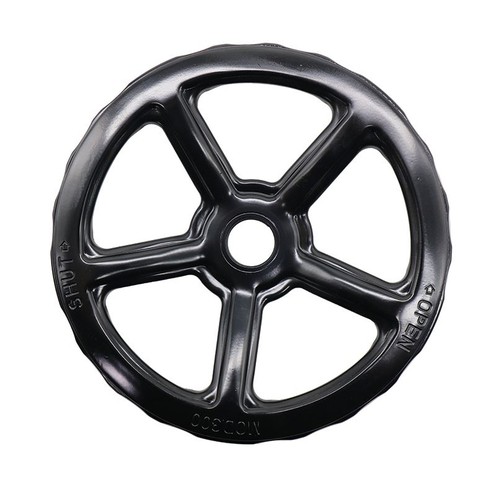
Carbon steel handwheels are mainly used for equipment operation control, and mechanical transmission and signal adjustment are achieved through the rotation of the handwheel. According to different manufacturing processes and application requirements, carbon steel handwheels are mainly divided into two categories: welded handwheels and stamped handwheels.
Welded handwheels
Welded handwheels are usually manufactured by casting or forging, and then assembled by precision machining and welding. The main features include:
Outer diameter range: generally φ125 to φ1200, suitable for medium and high load applications.
Center hub design: can be customized as round hole, keyway, square, hexagonal or D-type according to customer requirements to meet different transmission requirements.
Welding quality: The welding point is required to be smooth and firm, with exquisite surface treatment to ensure structural stability and durability.
Stamped handwheels
Stamped handwheels are mainly manufactured by stamping technology and have the following characteristics:
Outer diameter range: usually φ120 to φ500, suitable for light load and small and medium-sized equipment.
Integrated structure: Stamping makes the overall structure of the handwheel integrated, with exquisite appearance and convenient operation.
Process update: After several generations of process improvement, the stamped handwheel has been significantly improved in appearance and practicality.
3. Main content of production standards
The production standards of carbon steel handwheels involve multiple links. From raw materials to final products, each process has clear standard requirements. The main production standards of each link are introduced in detail below.
Raw material standards
Raw materials are the basis of product quality. Carbon steel handwheels usually use carbon steel materials with high mechanical properties and good processability. Common materials include Q235, Q345, etc. Standard requirements include:
Chemical composition: Strictly control the content of elements such as carbon, manganese, silicon, phosphorus, and sulfur to ensure that the material has the expected strength and toughness.
Physical properties: The material is required to have good plasticity, toughness and tensile strength to meet high-load working requirements.
Testing standards: All raw materials must pass national standards (such as GB/T standards) and be accompanied by relevant test reports to ensure that the source of the materials is reliable.
Processing technology standards
The processing technology plays a decisive role in the dimensional accuracy and concentricity of carbon steel handwheels. The standards mainly include:
CNC processing requirements: Use advanced CNC machine tools for cutting and turning to ensure that the product dimensional accuracy is at the micron level.
Surface roughness: The surface roughness of key contact surfaces and mounting surfaces is required to meet the national standards to ensure good sliding performance and stable assembly effects.
Process tolerance: The tolerance of each process must be strictly controlled to prevent cumulative errors from having a negative impact on the concentricity and stability of the final product.
Heat treatment and surface treatment standards
In order to improve the wear resistance and fatigue resistance of carbon steel handwheels, heat treatment and surface treatment are essential links. Standard requirements include:
Heat treatment process: Usually quenching and tempering processes are used to adjust the hardness and toughness of the material to ensure that the product can operate stably under high load and high temperature environments.
Surface treatment method: Sandblasting, galvanizing, electrophoresis or coating treatment is used to not only improve the appearance of the product, but also enhance corrosion resistance and wear resistance.
Testing standards: Hardness, toughness and metallographic structure tests must be carried out after heat treatment to ensure that the process effect meets expectations.
Assembly and testing standards
The assembly process and final testing are key links to ensure product concentricity and stability. Standard requirements include:
Precision alignment: During the assembly process, laser alignment instruments and turntable instruments must be used for precision calibration to ensure that the center of the handwheel and the axis are perfectly aligned.
Fastener standards: High-strength bolts and nuts are required, and they must be tightened strictly according to the specified torque to prevent eccentricity and vibration caused by improper assembly.
Comprehensive testing: Dynamic balancing tests, concentricity tests and vibration monitoring are required before the finished product leaves the factory to ensure that all products meet ISO9001:2015 and relevant national standards.
4. Material performance and selection standards
Carbon steel handwheel materials must meet the requirements of GB/T 700-2006 "Carbon Structural Steel":
| Parameters | Q235A standard value | Xiaoshan Chuangye measured value |
|---|---|---|
| Tensile strength | 375-500MPa | 420-480MPa |
| Yield strength | ≥235MPa | 245-260MPa |
| Elongation | ≥26% | 28-32% |
| Hardness (HB) | ≤160 | 140-155 |
The company uses a spectrometer to test 18 elements for each batch of steel to ensure that the sulfur and phosphorus contents are ≤0.045% and 0.045% respectively, eliminating the risk of brittle fracture from the source.
Our Product


5. Industry development trends and future prospects
International standard docking and certification system improvement
As global market competition intensifies, companies need to continuously improve their quality management systems and testing standards, pass international and domestic certifications such as ISO and GB/T, and enhance the competitiveness of their products in the international market.
Conculsion
As an indispensable key component in the mechanical transmission system, the concentricity and stability of the carbon steel handwheel directly affect the overall operation effect of the equipment. This article analyzes in detail the main contents of the carbon steel handwheel production standards and their impact on product performance from multiple aspects such as raw material selection, processing technology, heat treatment, assembly inspection and quality management. At the same time, through multiple case analyses, it further verifies the important role of strict production standards in ensuring efficient and stable operation of equipment.


