


Among the many devices in industrial production and daily life, the handwheel, a seemingly ordinary component, plays a vital role. It is simple and intuitive to operate, allowing users to flexibly control the operation of the equipment according to actual needs. From large machine tools to small instruments and meters, from industrial automation production lines to ordinary door and window adjustments, handwheels are widely used. So, what are the specific uses of handwheels? Next, we will analyze it in detail from different angles.
Contents
1. Uses of handwheels in industrial manufacturing
2. Application of handwheels in the transportation industry
3. The role of handwheels in medical equipment
4. Examples of handwheels in daily life
5. Uses of handwheels in scientific research experiments
6. Application of handwheels in special environments
1. Uses of handwheels in industrial manufacturing
Handwheel control in machine tool processing
During the machine tool processing process, the handwheel is an important tool for the operator to control the movement of the machine tool. Taking the CNC milling machine as an example, the operator can accurately control the movement of the tool on the three coordinate axes of X, Y, and Z by rotating the handwheel. The scale on the handwheel allows the operator to clearly understand the moving distance corresponding to each rotation, thereby realizing the fine processing of the workpiece. For example, when processing some high-precision molds, the operator needs to make slight adjustments to the position of the tool, and the handwheel plays a huge role at this time. By slowly and accurately rotating the handwheel, the operator can accurately move the tool to the specified position to ensure the processing accuracy.
In addition, handwheels are also indispensable in the debugging and maintenance of machine tools. Technicians can manually rotate the handwheel to gradually check the movement of each part of the machine tool, and promptly discover and solve potential problems. For example, when it is found that the movement of the machine tool on a certain coordinate axis is stuck, the technician can slowly move the coordinate axis through the handwheel, observe the working status of each transmission component, and find out the cause of the fault.
Handwheel debugging of automated production lines
Although the automated production line has achieved a high degree of automated production, the handwheel still plays an important role in the debugging and troubleshooting stage. During the installation and debugging of the production line, technicians need to accurately adjust the position and movement of each device. Through the handwheel, they can manually control the movement of each device to ensure the matching accuracy between the devices. For example, on an assembly line for electronic products, each component needs to be accurately installed on the product. Technicians can control the movement and rotation of the robot arm through the handwheel, adjust the robot arm to the best working position, and then perform precise assembly operations.
When a production line fails, the handwheel can also help technicians quickly locate and solve the problem. During the troubleshooting process, technicians can manually control the movement of the faulty equipment through the handwheel, observe the operating status of the equipment, and determine the cause of the failure. For example, if the sensor of a certain device fails and the equipment cannot operate normally, the technician can manually control the movement of the device through the handwheel, check whether the sensor signal is normal, and quickly find the fault point.
Manual operation assistance of industrial robots
Industrial robots are increasingly widely used in industrial production, but in some cases, they need to be manually operated. The handwheel is one of the important tools for manual operation of industrial robots. The operator can control the movement of each joint of the robot through the handwheel to achieve precise positioning and motion adjustment of the robot. For example, when the robot is performing welding operations, the operator can fine-tune the welding position and angle of the robot through the handwheel to ensure the welding quality.
Handwheels also play an important role in the programming and teaching process of robots. The operator can manually control the movement of the robot through the handwheel, record the movement trajectory and action parameters of the robot, and then input these parameters into the robot's control system to realize the robot's programming. This manual teaching method is simple and intuitive, allowing operators to quickly complete the robot's programming work.
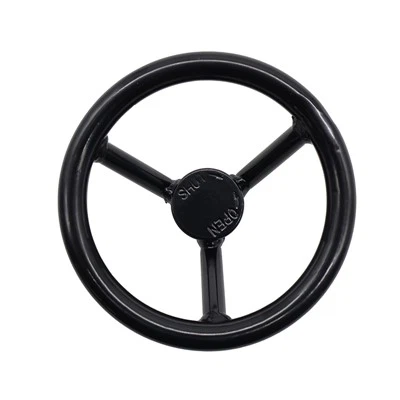
2. Handwheel application in the transportation industry
Handwheel function in the car
In the car, the handwheel usually refers to the steering wheel. The steering wheel is a key component for the driver to control the direction of the car. By turning the steering wheel, the driver can change the steering angle of the front wheels of the car, thereby realizing the car's turning, U-turn and other operations. The design and function of the steering wheel are different for different types of cars. For example, in some high-performance racing cars, various function buttons such as shift paddles and driving mode switching buttons are integrated on the steering wheel. The driver can complete various operations without leaving the steering wheel, which improves the convenience and safety of driving.
In addition to controlling the direction of travel, the steering wheel is also closely related to the car's safety system. The steering wheel of a modern car is usually equipped with an airbag, which will pop up instantly when a collision occurs to provide protection for the driver. In addition, some cars are also equipped with a steering wheel power-assist system, which provides assistance to the driver to turn the steering wheel through hydraulic or electric devices, reducing the driver's operating burden, especially when driving at low speed or parking, the role of the power-assist system is more obvious.
Handwheel operation of ship driving
In ship driving, the handwheel is an important tool for the driver to control the ship's course. The ship's steering wheel is similar to the steering wheel of a car. The driver controls the angle of the ship's rudder blade by turning the steering wheel, thereby changing the direction of the ship's travel. On large ships, the steering wheel is usually larger and requires the driver to use greater force to turn it. In order to reduce the driver's operating burden, some ships are equipped with a steering gear power-assist system, which provides assistance for the rotation of the steering wheel through hydraulic or electric devices.
In the operation of ships entering and leaving ports, berthing, etc., the operation of the steering wheel needs to be very precise. The driver needs to accurately control the turning angle and speed of the steering wheel according to factors such as the ship's speed, wind direction, and water flow to ensure that the ship can dock safely and accurately at the designated location. In addition, in an emergency, the driver needs to quickly turn the steering wheel to change the ship's course to avoid accidents such as collisions.
Handwheels for aviation equipment
Handwheels also have important applications in aviation equipment. For example, in the cockpit of an aircraft, the pilot controls the retraction and extension of the aircraft's flaps, landing gear and other components by turning the handwheel. The flap is a movable part on the wing of an aircraft. By changing the angle of the flap, the lift and drag of the aircraft can be increased or decreased, thereby affecting the take-off, landing and flight performance of the aircraft. By turning the handwheel, the pilot can accurately control the angle of the flap to ensure that the aircraft can maintain good performance in different flight phases.
In some small aircraft or helicopters, handwheels can also be used to control the attitude of the aircraft. The pilot adjusts the pitch, roll and yaw angles of the aircraft by turning the handwheel to achieve a smooth flight of the aircraft. In addition, when the aircraft's autopilot system fails, the pilot can manually turn the handwheel to control the flight of the aircraft to ensure flight safety.
3. The role of handwheels in medical equipment
Fine adjustment of medical equipment
In medical equipment, handwheels are often used to achieve fine adjustment of equipment. Taking the surgical microscope as an example, the surgical microscope needs to make precise adjustments to parameters such as focal length and magnification to meet the needs of the operation. The operator can control the focal length and magnification of the microscope by rotating the handwheel to ensure the clarity and accuracy of the surgical field of view. In ophthalmic surgery, doctors need to use surgical microscopes to observe and operate eye tissues in detail. Through the precise adjustment of the handwheel, the focus of the microscope can be adjusted to the optimal position to ensure the success of the operation.
In addition, some medical testing equipment, such as centrifuges and incubators, are also equipped with handwheels for adjusting the parameters of the equipment. For example, in a centrifuge, the operator can adjust the speed and time of the centrifuge by rotating the handwheel to ensure the separation effect of the sample. In an incubator, the handwheel can be used to adjust the temperature, humidity and other parameters of the incubator to provide a suitable environment for the culture of cells and tissues.
Operation control of medical imaging equipment
In medical imaging equipment, the handwheel is also an important tool for operators to control the equipment. Taking a CT scanner as an example, the operator can control the movement of the scanning bed and the adjustment of the scanning angle by rotating the handwheel. During a CT scan, the patient needs to lie on the scanning bed, and the operator moves the scanning bed to the appropriate position through the handwheel, and then adjusts the scanning angle to ensure that clear and accurate image data can be obtained.
In magnetic resonance imaging (MRI) equipment, the handwheel is also used to control the adjustment of scanning parameters. The operator can adjust the magnetic field strength, gradient magnetic field and other parameters by rotating the handwheel to obtain different types of image data. In addition, the handwheel can also be used to control the zooming, translation and other operations of the image, which is convenient for doctors to observe and analyze the image.
4. Examples of handwheels in daily life
Adjustment handwheels for furniture and doors and windows
In furniture and doors and windows, handwheels are often used to adjust components. For example, some office chairs are equipped with handwheels for adjusting the height and tilt angle of the seat. The operator can change the air pressure or mechanical structure inside the seat by rotating the handwheel, thereby adjusting the height and tilt angle of the seat. This adjustment method is simple and convenient and can meet the needs of different users.
In terms of doors and windows, some sliding doors and windows are equipped with handwheels to adjust the opening and closing degree and sealing performance of doors and windows. By rotating the handwheel, the pulley or lock of the door and window can be moved, so as to realize the opening and closing and sealing of the door and window. In some high-end doors and windows, the handwheel can also be used to adjust the sound insulation and heat insulation performance of the door and window to improve the comfort of the room.
Handwheel adjustment of fitness equipment
In fitness equipment, handwheels are also widely used. Take the treadmill as an example. The treadmill is usually equipped with a handwheel to adjust the speed and slope of the running belt. Users can increase or decrease the speed of the running belt by rotating the handwheel to simulate different running scenes. At the same time, the handwheel can also be used to adjust the slope of the treadmill to increase the difficulty and intensity of running.
In some strength training equipment, the handwheel is used to adjust the resistance. For example, in the dumbbell trainer, the user can change the weight or resistance of the dumbbell by rotating the handwheel to meet different training needs. This adjustment method is simple and intuitive, allowing users to flexibly adjust according to their physical condition and training goals.
5. The use of handwheels in scientific research experiments
Manual control of laboratory instruments
In scientific research laboratories, many instruments and equipment are equipped with handwheels for manual control. Taking the microscope as an example, in addition to the surgical microscope mentioned above, ordinary optical microscopes also need to use handwheels to adjust the focal length and the movement of the stage. Researchers can adjust the focal length of the microscope to the optimal position by rotating the handwheel to observe the microstructure of the sample. At the same time, the handwheel can control the forward and backward, left and right movement of the stage, which is convenient for researchers to observe different parts of the sample.
In some chemical experimental equipment, handwheels are also used to control experimental parameters. For example, in a distillation device, the operator can control the heating temperature of the distillation flask and the flow rate of condensed water by rotating the handwheel to ensure the smooth progress of the distillation process. In some gas analysis instruments, handwheels can be used to adjust the flow and pressure of the gas to ensure the accuracy of experimental data.
Handwheel adjustment of astronomical observation equipment
In astronomical observation, the handwheel is one of the important tools for operating astronomical telescopes. Astronomical telescopes need to accurately track and observe the position of celestial bodies. By rotating the handwheel, the azimuth and altitude angle of the telescope can be controlled to aim the telescope at the target celestial body. During the observation process, due to the rotation of the earth, the position of the celestial body will continue to change. The operator needs to constantly fine-tune the position of the telescope through the handwheel to ensure that the celestial body is always in the center of the telescope's field of view.
In addition, the handwheel can also be used to adjust the focal length and magnification of the telescope. Different celestial bodies require different focal lengths and magnifications for observation. The operator can adjust the optical system of the telescope by rotating the handwheel to obtain clear and accurate images of the celestial body.
6. Application of handwheels in special environments
Design and use of handwheels in high temperature and high pressure environments
In some high temperature and high pressure industrial environments, such as chemical and metallurgical industries, the design and use of handwheels need to consider special requirements. The handwheels in these environments need to have high temperature and high pressure resistance, while also ensuring the safety of the operator. For example, in a chemical reactor, the operator needs to use a handwheel to control the feeding, discharging and stirring of the reactor. The material of the handwheel is usually made of high temperature and corrosion resistant metal materials, such as stainless steel, titanium alloy, etc. At the same time, the surface of the handwheel needs to be specially treated to prevent high temperature from causing burns to the operator.
In order to ensure the safety of operation in high temperature and high pressure environment, the handwheel is usually equipped with a protective device. For example, a protective cover is set around the handwheel of some high temperature reactors to prevent the operator from accidentally touching the handwheel and causing an accident. In addition, the operating force of the handwheel also needs to be reasonably designed to ensure that the operator can easily turn the handwheel and prevent the handwheel from rotating by itself under high temperature and high pressure.
Safety guarantee of handwheels in explosion-proof environment
In some flammable and explosive environments, such as oil and natural gas industries, the use of handwheels needs to pay special attention to explosion-proof safety. The handwheels in these environments need to adopt an explosion-proof design to prevent sparks from causing explosion accidents during operation. The material of the handwheel is usually selected from metal materials that do not generate sparks, such as copper alloys. At the same time, the surface of the handwheel needs to be specially treated to reduce the friction coefficient and reduce the possibility of sparks.
In order to ensure the safety of operation in an explosion-proof environment, the handwheel is usually equipped with an explosion-proof switch and a protective device. For example, an explosion-proof switch is set on the handwheel of some oil storage tanks, and the handwheel can only be turned when the switch is in the off state. In addition, a guardrail is set around the handwheel to prevent the operator from accidentally touching the handwheel and causing an accident.
Summary
As a simple and practical operating tool, the handwheel is widely used in many fields such as industrial manufacturing, transportation, medical equipment, daily life, scientific research experiments and special environments. It can help operators accurately control the movement and parameters of the equipment and improve work efficiency and product quality. In industrial manufacturing, the handwheel is an important tool for machine tool processing, automated production line debugging and industrial robot operation; in the transportation industry, the handwheel is used for direction control and component adjustment of automobiles, ships and aviation equipment; in medical equipment, the handwheel realizes fine adjustment of medical equipment and imaging equipment; in daily life, handwheels appear on furniture, doors and windows, fitness equipment and other items, bringing convenience to people's lives; in scientific research experiments, handwheels are used for manual control of laboratory instruments and astronomical observation equipment; in special environments, the handwheel is specially designed to meet special requirements such as high temperature, high pressure and explosion-proof.


