


Table of contents
1. Industry background: safety hazards caused by loose handwheel
2. Cause analysis: in-depth analysis from structure to operation and maintenance
3. Solution: full-chain response strategy
4. Technical transformation case: practical exploration of a water supply company
5. Suggestions for the construction of a preventive maintenance system
6. Expert opinion: industry technology development trend
1. Industry background: safety hazards caused by loose handwheel
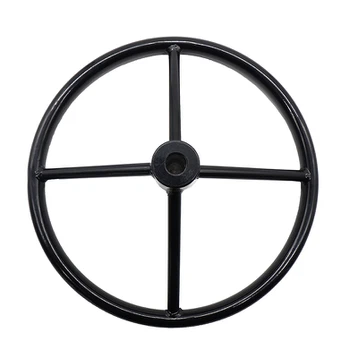
As the core control component in the petroleum, chemical, water supply and other industrial fields, the handwheel system of the gate valve is directly related to the opening and closing accuracy and safety of the valve. According to statistics, in 2024, 12.3% of domestic industrial accidents were caused by valve operation failures, of which more than 40% were caused by loose handwheels. A typical case includes a petrochemical enterprise that failed to work due to medium leakage caused by the failure of handwheel fasteners, resulting in a 72-hour production line shutdown and direct economic losses of more than 5 million yuan.
The industry standard "GB/T 12234-2019 Bolted Bonnet Steel Gate Valve for Petroleum and Natural Gas Industry" clearly requires that the handwheel system should have anti-vibration loosening characteristics. However, in actual operation and maintenance, affected by operating habits, environmental factors, etc., handwheel loosening still becomes a high-frequency failure point, and a systematic solution is urgently needed.
2. Cause analysis: in-depth analysis from structure to operation and maintenance
1. Mechanical structural defects
Thread mismatch: The thread wear rate at the connection between the valve stem and the handwheel is 0.3mm/year, resulting in a decrease in self-locking performance
Weak fastening system: Traditional spring washers are prone to loosening in a vibrating environment. A test data shows that the fastening force of a DN150 gate valve decays by 47% after 2,000 operations
2. Improper operation and maintenance
Over-limit operation: 38% of operators use non-standard tools such as pipe clamps to increase force, causing structural damage
Lack of lubrication: 65% of faulty valves have grease drying, and the friction coefficient increases by 3-5 times
3. Environmental erosion effects
Corrosive medium penetration: The annual corrosion rate of handwheel bolts of valves in the chemical industry reaches 0.15mm, reducing the connection strength
Thermal stress deformation: Under conditions where the temperature difference exceeds 80°C, the difference in metal expansion causes the fit clearance to expand
3. Solution: full-chain response strategy
1. Emergency treatment plan
Four-step quick repair method:
1. Use an explosion-proof torque wrench to re-tighten (standard torque refers to ISO 16047)
2. Inject molybdenum disulfide-based high-temperature grease (applicable to -50℃~400℃)
3. Install anti-loosening gaskets (Nord-Lock wedge-shaped locking washers are recommended)
4. Check the straightness of the valve stem (error ≤0.05mm/m)
2. Structural transformation technology
Dual bearing support system: Change sliding friction to rolling friction. A transformation case shows that the opening and closing torque is reduced by 62%
Intelligent monitoring handwheel: Integrated strain sensor, real-time monitoring of tightening force status and early warning
3. Upgrade of operation and maintenance standards
Six-dimensional maintenance system:
Daily:
Visually check handwheel offset (≤2mm)
Weekly:
Add grease (5-8g)
Monthly:
Torque calibration (using a calibrated wrench)
Quarterly:
Anti-corrosion coating repair
Yearly:
Disassemble for deep maintenance
Every three years:
Replace thread pair
4. Technical transformation case: practical exploration of a water supply company
Hangzhou Xiaoshan Chuangye Metal Processing Co., Ltd. comprehensively renovated the DN150 gate valve:
Structural optimization: an improved handwheel bracket with a needle bearing was used, and the friction resistance was reduced to 28% of the original design
Material upgrade: the valve stem nut was replaced with SAE 660 bronze material, and the wear resistance was increased by 3 times
Intelligent operation and maintenance: an IoT monitoring terminal was installed to achieve a loosening warning accuracy rate of 98.7%. After the transformation, the operation and maintenance cost decreased by 41%, and the valve life was extended to 8.2 years (the original design life was 5 years)
5. Suggestions for the construction of a preventive maintenance system
1. Full life cycle management
Design phase: Use finite element analysis to optimize the load-bearing structure
Installation phase: Implement laser centering calibration (accuracy 0.01mm)
Operation and maintenance phase: Establish digital health records
2. Personnel capacity building
Develop VR simulation training system, covering 12 types of typical fault handling
Promote ASME B31.3 standard certification assessment
3. Spare parts management innovation
Establish 3D printing emergency spare parts library, shorten the delivery cycle to 4 hours
Apply blockchain technology to achieve spare parts traceability
6. Expert opinion: industry technology development trend
Li Ming, senior engineer of China Valve Association, pointed out:
Material revolution: Graphene-enhanced composite materials will improve the wear resistance of threaded pairs by 5-8 times
Intelligent upgrade: In 2025, more than 60% of industrial valves will be equipped with self-tightening handwheel systems
Standard evolution: The new version of API 600 standard will increase dynamic load test requirements
Conclusion
The solution to the problem of loose handwheels requires breakthroughs in multiple dimensions such as design improvement, intelligent monitoring, and standard upgrades. With the improvement of the reliability requirements of key basic parts in "Made in China 2025", the industry is accelerating its transformation to preventive maintenance and intelligent operation and maintenance, and it is expected that a professional
service market of more than 10 billion will be formed in the next three years. Enterprises should seize the window period of technology upgrade and build full-chain solution capabilities.


